
Touchless vs. Manual Faucets: Which Is Better for Airports?
Airport restrooms are high-traffic, high-visibility spaces where faucet selection directly affects hygiene, water control, passenger flow, maintenance, accessibility, and long-term operating cost. Manual faucets still offer simplicity and direct control, but touchless faucets increasingly fit the way modern airports manage cleanliness, sustainability, and passenger confidence.
In This Guide
Quick verdict Airport faucet data Touchless faucet advantages Manual faucet advantages Full comparison table Airport restroom case model Specification checklist FAQs Reference sources
Quick Verdict
For most modern airport public restrooms, touchless faucets are usually the better long-term choice because they reduce shared touchpoints, control run time, support water-saving programs, and create a more modern passenger experience. Manual faucets can still be appropriate in staff-only areas, maintenance buildings, low-traffic restrooms, or locations where simplicity and low upfront cost are the highest priorities.
The best answer is not always “touchless everywhere.” Airports should match faucet type to restroom traffic, maintenance capability, water goals, accessibility requirements, and design standards. A major international terminal may prioritize sensor faucets and data-backed maintenance, while a small aviation workshop restroom may prefer durable manual controls.
Hygiene
Touchless faucets reduce the need to touch a shared handle after washing.
Water Control
Sensor shutoff limits unnecessary run time during passenger surges.
Simplicity
Manual faucets are easier to understand, repair, and operate without electronics.
Passenger Trust
Modern airport users often associate touchless restrooms with cleaner facilities.
Airport Faucet Data
Airport restrooms operate under unusual demand: long operating hours, peak passenger waves, frequent cleaning, strict accessibility requirements, and high visibility. EPA WaterSense reports that replacing old, inefficient faucets and aerators with WaterSense-labeled models can save the average family about 700 gallons of water per year. Airports are not households, but the same principle scales: lower flow plus automatic shutoff can significantly reduce unnecessary water use in high-volume restroom banks.
Airport-focused touchless faucet resources also emphasize hygiene, durability, sensor accuracy, water efficiency, and maintenance requirements as key criteria in airport restrooms. Manual faucet suppliers, meanwhile, highlight direct water control and heavy-duty commercial construction as advantages for demanding facilities.
Why Airports Choose Touchless Faucets
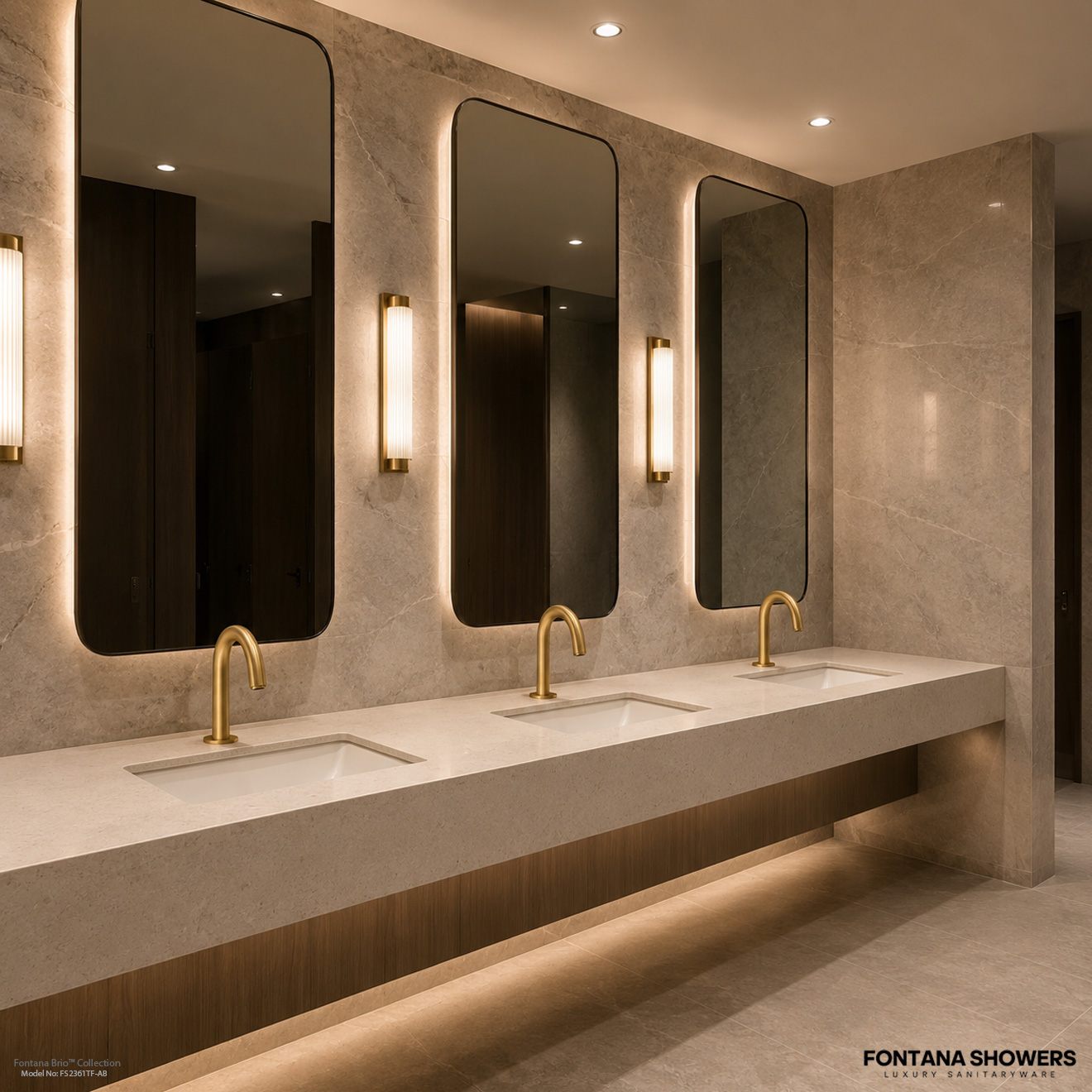
Touchless faucets are designed for high-throughput public spaces. In airports, they help passengers wash quickly without touching faucet handles, and they automatically stop water when hands are removed or when the programmed cycle ends. This makes them especially useful in restrooms serving gates, security exits, arrivals halls, baggage claim, lounges, and food courts.
Touchless Strengths
- Reduces shared handle contact
- Supports modern hygiene expectations
- Limits water left running
- Improves passenger perception of cleanliness
- Works well with automatic soap systems
- Can support maintenance and usage analytics in smart restrooms
Touchless Watchouts
- Requires sensor calibration
- Needs battery or hardwired power planning
- May require more specialized replacement parts
- Dirty sensor lenses can cause false or missed activation
- Higher upfront cost than many manual fixtures
Why Some Areas Still Use Manual Faucets
Manual faucets are not obsolete. In some aviation facilities, they remain practical because they are mechanically simple, familiar to users, and easy for maintenance staff to repair. A heavy-duty manual faucet can be a good fit in employee restrooms, maintenance buildings, crew areas, cargo facilities, or very low-traffic passenger areas.
The main limitation is that manual faucets require physical contact. Passengers may touch handles before washing and again after washing unless the fixture is designed with a self-closing or metering function. Manual faucets may also be left running if users do not fully close them.
Manual Strengths
- Lower upfront fixture cost
- No batteries or electronics
- Direct user control over flow and temperature
- Simple troubleshooting for maintenance teams
- Durable options available for commercial use
Manual Watchouts
- More shared touchpoints
- Water can be left running
- Less modern passenger perception
- Handles may show wear faster in public restrooms
- Can reduce hygiene confidence in high-traffic terminal restrooms
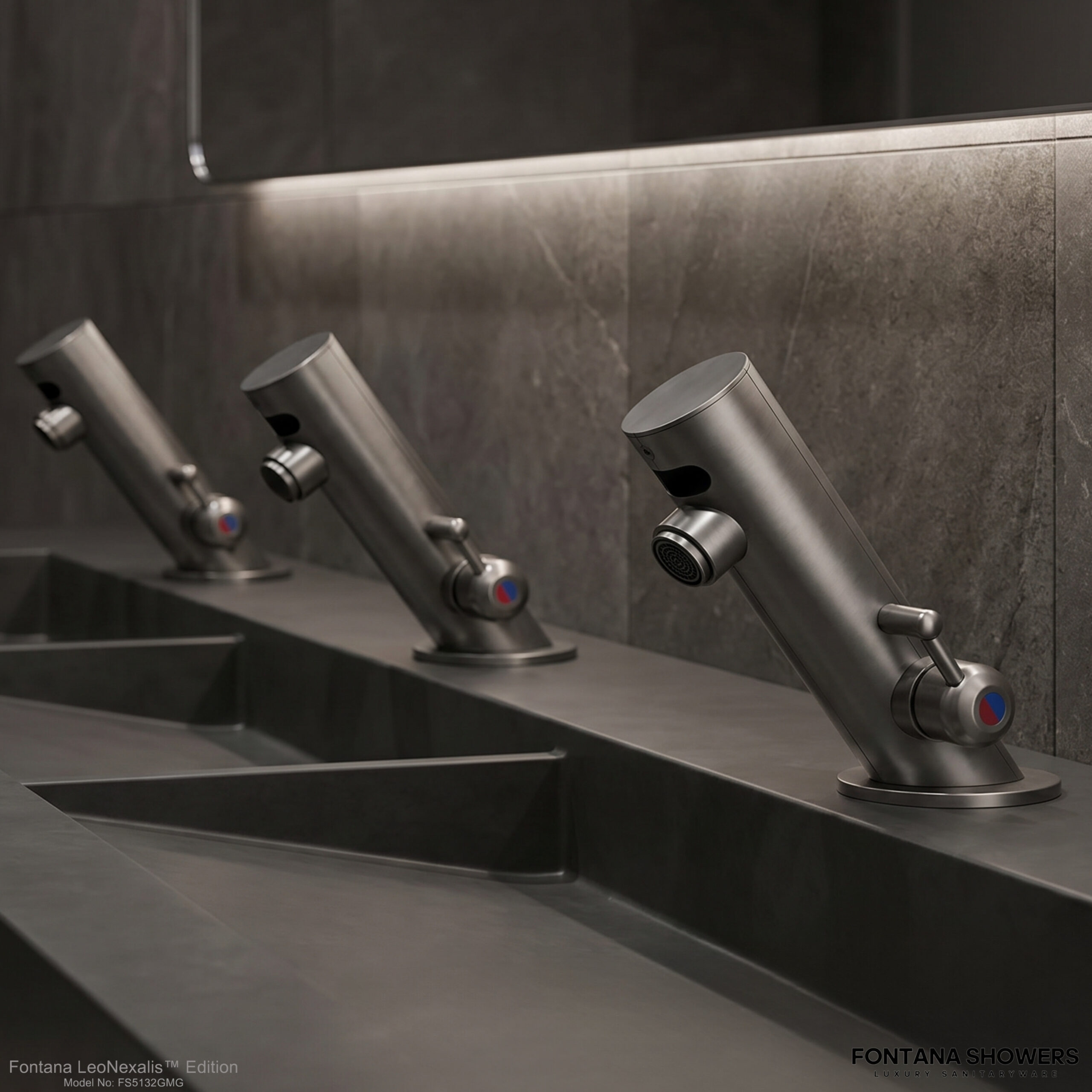
Full Comparison Table
| Category | Touchless Faucets | Manual Faucets | Airport Recommendation |
|---|---|---|---|
| Hygiene | Best for reducing faucet-handle contact | Requires handle contact unless paired with special controls | Touchless for public passenger restrooms |
| Water Efficiency | Automatic shutoff limits run time | Depends on user behavior or self-closing design | Touchless or metered for high-volume areas |
| Maintenance | Needs sensor, power, solenoid, and aerator checks | Mechanical repairs are usually simpler | Match to maintenance team capability |
| Upfront Cost | Usually higher | Usually lower | Manual may fit low-traffic back-of-house areas |
| Passenger Experience | Modern, clean, expected in upgraded airports | Familiar but less premium in public terminals | Touchless for visible passenger-facing spaces |
| Accessibility | Can be easy to use if sensor range is correct | Must avoid tight grasping, pinching, or twisting when accessibility applies | Review full ADA/accessibility design either way |
| Failure Mode | Sensor/power issues, solenoid problems, clogged aerators | Leaks, worn cartridges, loose handles, user misuse | Preventive maintenance required for both |
| Best Location | Concourses, arrivals, lounges, family restrooms, food court restrooms | Staff areas, maintenance buildings, cargo facilities, low-traffic locations | Use a mixed strategy by space type |
Case Model: Busy Concourse
Consider a restroom bank near a major gate cluster. The restroom sees heavy use before boarding, after arrivals, and during weather delays. Manual faucets may be durable, but handle contact and inconsistent shutoff can reduce hygiene confidence and increase water waste. A touchless retrofit can improve the passenger-facing experience when paired with proper maintenance.
| Before Retrofit | After Touchless Upgrade | Measured Result to Track |
|---|---|---|
| Manual handles touched before and after washing | Hands-free activation and shutoff | Passenger feedback and hygiene perception |
| Water sometimes left running | Automatic shutoff limits run time | Water-use trend by restroom bank |
| Cartridge and handle wear | Sensor, solenoid, and aerator maintenance | Service calls by fixture type |
| Traditional restroom impression | Modern, low-contact sink zone | Customer-experience score and complaint volume |
Specification Checklist
Use this checklist before choosing touchless or manual faucets for an airport restroom project.
Use touchless faucets where passenger volume is high and restroom turnover is fast.
For touchless faucets, plan hardwired power, battery backup, or scheduled battery replacement.
Specify low-flow aerators, automatic shutoff, and metered timing where conservation matters.
Check access to solenoids, filters, aerators, supply stops, batteries, and mixing valves.
Verify reach range, clear floor space, sink height, knee clearance, and control operation.
Standardize faucet families and stock aerators, batteries, cartridges, sensors, solenoids, and power supplies.
FAQs
Are touchless faucets better than manual faucets for airports?
For most public passenger restrooms, yes. Touchless faucets reduce shared handle contact, support water control, and create a more modern restroom experience.
Are manual faucets still acceptable in airport facilities?
Yes. Manual faucets can still work well in staff restrooms, maintenance buildings, low-traffic facilities, or areas where simple mechanical repair is preferred.
Do touchless faucets always save water?
They can reduce waste through automatic shutoff, but savings depend on sensor calibration, flow rate, maintenance, water pressure, and the previous faucet type.
Which faucet type is easier to maintain?
Manual faucets are usually simpler mechanically. Touchless faucets require sensor, power, solenoid, and aerator checks, but they can reduce other operational problems when maintained properly.
Do touchless faucets need batteries?
Some do. Others are hardwired or use hybrid power. High-traffic airport restrooms often benefit from hardwired power with battery backup.
Are touchless faucets ADA-friendly?
They can be, but the full sink area must be designed correctly. Sensor range, clear floor space, reach range, lavatory height, and accessory placement all matter.
What is the best faucet setup for a major airport terminal?
A common best practice is touchless faucets with low-flow aerators, automatic soap dispensers, hardwired power, battery backup, serviceable filters, and a preventive maintenance schedule.
What is the biggest mistake when installing touchless faucets?
The biggest mistake is installing sensor faucets without a maintenance plan for batteries, sensor cleaning, aerator cleaning, solenoids, and spare parts.
Conclusion
Touchless faucets are generally the stronger choice for modern airport public restrooms because they support hygiene confidence, water control, passenger flow, and a cleaner restroom image. Manual faucets still have value in low-traffic or back-of-house aviation spaces where simplicity, direct user control, and lower upfront cost matter most.
The smartest airport strategy is not one-size-fits-all. Use touchless faucets in passenger-facing terminals, lounges, family restrooms, arrivals halls, and food-court restrooms. Use manual faucets selectively in operational areas where the environment is lower traffic and maintenance simplicity is the priority.
Reference Sources
Use these authority and product-reference sources for additional review. Each link opens in a new tab.