
Best Fontanaaviationfaucets for 2026 — Ultimate Guide
Choosing the best aviation faucet requires more than selecting an attractive finish. Airport terminal restrooms, airline lounges, private aviation facilities, and other high-traffic commercial environments need reliable water delivery, durable materials, effective sensor operation, accessible design, and practical maintenance access.
This 2026 guide explores the faucet configurations, technical specifications, installation considerations, and lifecycle factors that matter most to architects, plumbing engineers, airport operators, facility managers, and procurement teams.

What Makes an Aviation Faucet Suitable for 2026?
The best aviation faucets for 2026 are those that match the operating demands of their intended facility. A busy airport concourse may require touchless activation, consistent flow under changing supply conditions, accessible sensor placement, and standardized replacement components. An executive aviation lounge may place greater emphasis on quiet operation, discreet technology, and premium finish coordination.
Aviation facility plumbing should therefore be assessed as a complete system. The faucet, sink, water distribution network, mixing equipment, electrical supply, sensor, solenoid, and service access must function together.
Read More — Engineering Priorities
Unlike decorative fixtures selected primarily for residential use, faucets installed throughout airport infrastructure can experience frequent operation over extended daily schedules. The relevant design criteria include mechanical wear, electronic reliability, water pressure fluctuations, scale accumulation, cleaning procedures, vandal resistance, and the time required to complete repairs.
Sensor faucets use electronic detection systems to initiate water delivery. In typical infrared configurations, an emitter and receiver identify a user within the detection field and instruct an electronic controller to operate a solenoid valve. Correct sensor positioning is essential: reflective basins, lighting conditions, faucet geometry, and user approach can affect performance.
A reliable specification documents operational pressure, flow rate, electrical supply, sensor adjustment, mixing requirements, component accessibility, installation tolerances, and applicable product certifications.
Best Aviation Faucet Types for Different Applications
There is no single faucet configuration suitable for every aviation project. The most practical choices depend on passenger volume, basin design, available power, maintenance capabilities, and the architectural character of the facility.
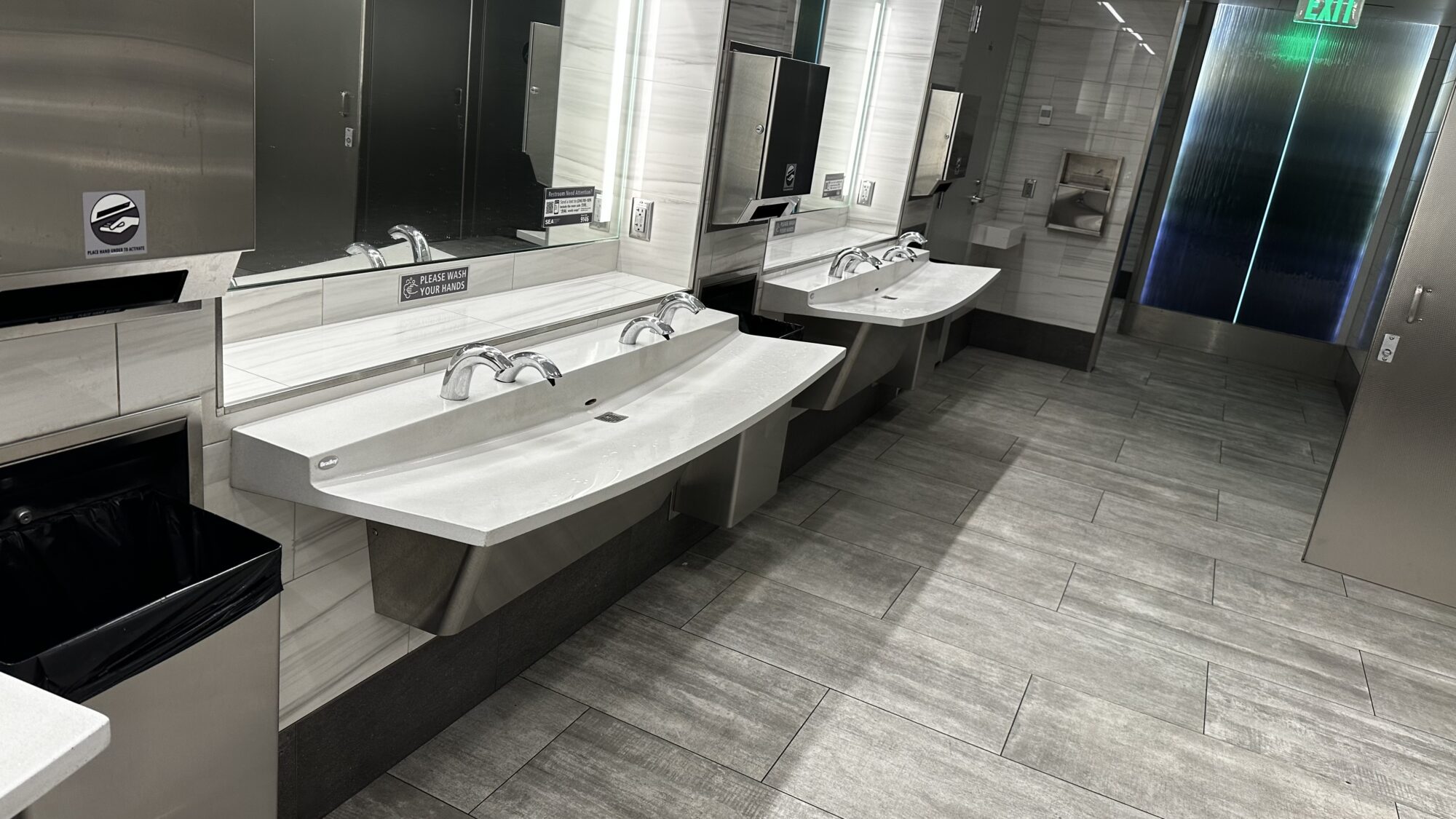
Deck-Mounted Touchless Faucets
A versatile solution for airport restroom counters and integrated lavatory installations. Deck mounting can simplify replacement where compatible countertop openings and service access already exist.
View More
Evaluate mounting-hole dimensions, spout projection, sealing details, sensor positioning, under-counter clearances, control-box accessibility, and compatible water connections. Plumbing and electronic components should remain accessible without unnecessarily dismantling the sink assembly.
Wall-Mounted Sensor Faucets
Suitable for contemporary terminals and premium washrooms where uncluttered counters, coordinated finishes, and accessible countertop cleaning are priorities.
View More
Wall-mounted configurations require accurate rough-in coordination and access to concealed components. Evaluate the finished-wall thickness, faucet projection, basin depth, sensor alignment, waterproofing, service panel location, and distance between water discharge and the drainage zone.
Hardwired Electronic Faucets
Worth considering for frequently used facilities when permanent electrical infrastructure and accessible maintenance provisions are available.
Learn More
Confirm supply voltage, transformer specifications, wiring protection, controller ratings, power-failure behavior, and electrical installation requirements. Some systems support battery backup, but this must be verified for the actual model.
Battery-Powered Sensor Faucets
A practical retrofit option in certain existing restrooms where introducing new electrical wiring would increase construction complexity.
Learn More
Evaluate expected battery service life using the manufacturer’s duty-cycle assumptions. Consider battery accessibility, low-power indication, replacement scheduling, and performance under sustained high-traffic usage. Battery duration should not be assumed from general marketing claims.
Comparing Aviation Faucet Technologies
Procurement decisions should account for installation complexity, mechanical service requirements, user interaction, and lifecycle cost rather than fixture purchase price alone.
| Configuration | Primary Benefit | Design Consideration | Typical Application |
|---|---|---|---|
| Deck-mounted sensor | Hands-free operation with common mounting geometry | Under-counter controller and valve access | Terminal restroom counters |
| Wall-mounted sensor | Clean counter presentation | Concealed rough-in and access coordination | Airport lounges and premium restrooms |
| Hardwired sensor | No routine faucet battery replacement where fully mains-powered | Approved power supply and wiring provision | High-demand washrooms |
| Battery-powered sensor | Reduced need for new wiring | Battery replacement and service intervals | Selected retrofit projects |
| Manual commercial faucet | Straightforward mechanical operation | Handle durability and user accessibility | Staff facilities and selected utility areas |
Technical Specifications That Matter Most
Well-written commercial faucet specifications help reduce installation conflicts, unplanned substitutions, and future maintenance problems. The following parameters deserve attention during architectural and plumbing design review.
Water Flow
Specify the rated flow rate at its stated test pressure. Low-flow designs may support reduced water use when matched to suitable basin geometry and operating needs.
Pressure Range
Verify minimum and maximum operating pressure, dynamic pressure during simultaneous use, and the performance of flow-control components.
Material Construction
Review the documented body material, wetted components, seals, finish durability, corrosion resistance, and cleaning-chemical compatibility.
Sensor Detection
Check detection range, target sensitivity, activation timing, automatic shutoff, false-trigger resistance, and basin compatibility.
Power Architecture
Identify battery, hardwired, or hybrid requirements and confirm the accessibility of electrical connections and control components.
Maintenance Access
Provide access to filters, aerators, solenoids, power supplies, mixing valves, isolation valves, and replacement connections.
Read More — Flow Rate and Water Efficiency
Commercial lavatory faucet projects often evaluate nominal flow options such as 0.35, 0.5, and 1.5 gallons per minute. These are example specification values, not confirmed flow ratings of every aviation faucet. The permitted and preferred rate depends on the applicable plumbing code, occupancy, product category, and project performance requirements.
Flow regulation should provide adequate handwashing performance while minimizing splashing. Engineers should test the relationship between spout reach, discharge angle, sink bowl depth, drain position, and water pressure. Selecting a lower flow rate does not automatically guarantee better performance if users repeatedly activate the faucet or experience inadequate rinsing.
Where relevant, review ASME A112.18.1/CSA B125.1, NSF/ANSI/CAN 61 and 372, applicable water-efficiency requirements, and the manufacturer’s documented product scope.
Read More — Sensor and Solenoid Engineering
The electronic sensing and valve-control system often determines whether a commercial touchless faucet will operate consistently in everyday use. Infrared systems commonly measure reflected light, while some newer sensing approaches use different distance-detection methods. Performance cannot be inferred from the sensing category alone.
Review optical interference, reflective countertop surfaces, controller protection, water ingress, solenoid response, debris filtration, and automatic timeout settings. Valves must be selected for actual supply conditions, including possible transient pressure events and pressure differentials.
For facilities with several fixtures on the same distribution branch, plumbing engineers should also evaluate simultaneous demand, pressure losses, water temperature delivery, and hydraulic balancing.
Review the Engineering Framework
Explore the research platform’s information about aviation faucet materials, hydraulic systems, electronic controls, reliability modeling, and airport infrastructure.
Aviation Faucet Engineering ResearchMaterials, Finishes and Commercial Restroom Design
Fixture durability depends on the entire material and finish system, not simply its appearance. Metal body construction, surface treatment, joint design, sealing materials, and compatible cleaning methods influence long-term condition.

Commercial Metal Finishes
Polished chrome, brushed metal, and other protective finishes can suit aviation facility interiors. Evaluate finish performance against the facility’s cleaning program and manufacturer instructions.
Architectural Coordination
Faucet projection, basin shape, mirror position, accessible approach, and maintenance openings should be coordinated before the final selection of a decorative finish.
Learn More — Material and Finish Selection
Commercial brass alloys and stainless-steel components are used across the plumbing industry, although individual product construction varies. Engineers should verify the exact material specifications rather than assuming identical corrosion resistance, mechanical strength, or potable-water suitability.
In airport facilities, cleaning personnel may use disinfectants repeatedly throughout the day. Incorrect chemical selection, excessive abrasion, and prolonged exposure can damage protective coatings, seals, and electronic sensor windows. Maintenance instructions should identify approved cleaning methods and serviceable components.
Where Commercial Aviation Faucet Designs Work Best
Engineering principles applied to airport restrooms are also relevant to other large public and commercial environments. Each facility introduces different usage patterns, operational expectations, and maintenance constraints.
Airport Terminals
Prioritize reliable high-frequency operation, coordinated accessible lavatories, efficient water delivery, and rapid service access.
Airline Lounges
Combine commercial durability with discreet activation, attractive finishes, quiet operation, and premium restroom presentation.
Hotels and Hospitality
Consider touchless fixtures for public lobbies, conference restrooms, banquet spaces, and frequently used shared washrooms.
Shopping Malls
Emphasize high-use durability, predictable sensor response, low-maintenance finishes, and readily available service parts.
Stadiums and Arenas
Plan for intense peak-demand periods, robust fixture mounting, controlled flow, and efficient restroom servicing.
Corporate and Aviation Offices
Select fixtures appropriate for employee facilities, operational support areas, visitor restrooms, and executive lounges.
Read More — Designing for Heavy Traffic
Airports, sports venues, shopping centers, and convention facilities experience variable demand. During peak periods, a large number of users may operate neighboring fixtures within a short interval. This places demand on branch piping, valves, temperature-control equipment, and the broader water distribution system.
Designers should estimate simultaneous fixture usage, confirm pressure availability, coordinate hot-water supply and mixing, and choose an appropriate maintenance strategy. Standardizing selected components across similar washrooms can simplify spare-parts storage and technician training, provided the fixtures meet each location’s requirements.
In hospitality settings, appearance and acoustic comfort may receive greater emphasis. In sports venues, vandal resistance and peak throughput can become more prominent. The engineering objective is to adapt the fixture system to the occupancy rather than assume that every public restroom has identical demands.
ADA and Aviation Restroom Accessibility Considerations
A sensor-operated faucet may reduce the need for manual handle manipulation, but touchless operation alone does not establish accessibility compliance. The full lavatory installation must accommodate the intended users.
Physical Accessibility
Review clear floor space, reach ranges, lavatory heights, knee and toe clearances, exposed piping protection, and approach geometry against applicable standards.
Temperature Protection
Confirm appropriate water temperature control, scald protection, mixing arrangement, and the governing requirements for the facility or aircraft installation.
Read More — Regulatory Coordination
Public airport terminal restrooms are generally evaluated using applicable accessibility, building, and plumbing requirements, together with airport authority project standards. Relevant guidance includes the 2010 ADA Standards for Accessible Design and U.S. Access Board resources.
Aircraft lavatories follow a distinct regulatory framework. Under 14 CFR Part 382, certain newly delivered single-aisle aircraft have specific accessibility requirements, including provisions concerning lavatory faucet controls and minimum water delivery time. The precise application depends on the aircraft and regulatory conditions.
Aircraft-installed replacement or modification articles also require an appropriate regulatory production and installation basis. Project teams should not describe a faucet as FAA-approved, aircraft-certified, or ADA-compliant without supporting documentation for that specific product and installation.
Regulatory reference: 14 CFR Part 382 and 2010 ADA Standards.
Maintenance, Reliability and Lifecycle Cost
Commercial faucet value should be evaluated over the expected service period, including maintenance labor, downtime, water consumption, replacement components, and installation accessibility.
| Service Area | Typical Inspection | Operational Benefit |
|---|---|---|
| Sensor window | Clean and verify detection behavior | Consistent activation |
| Aerator or outlet | Check for sediment or scale accumulation | Stable flow pattern |
| Solenoid and filter | Check operation and debris accumulation | Reduced flow-control issues |
| Power supply | Check batteries, wiring, and rated supply | Reduced interruption risk |
| Connections and seals | Inspect for leaks and deterioration | Lower water-damage risk |
| Temperature controls | Verify delivered temperature and valve function | Safer operation |
Read More — Lifecycle Cost Analysis
An initial faucet purchase represents only one part of total ownership cost. Service labor, replacement valve assemblies, sensor modules, batteries, power supplies, cleaning requirements, water consumption, and restroom downtime can influence the final cost over a multi-year operating period.
A useful lifecycle assessment compares documented expected component service life, manufacturer warranty terms, parts availability, service procedures, and site-specific operating conditions. Where possible, facility teams should record actual maintenance histories to refine later procurement decisions.
Electronic faucets are not inherently maintenance-free. Their value depends on dependable controls, correct commissioning, suitable hydraulic conditions, and a realistic inspection program.
Explore Aviation Faucet Engineering Studies
Review technical discussions concerning sensor reliability, hydraulics, maintenance, and infrastructure performance.
Aviation Engineering Case StudiesWhat to Check Before Buying Aviation Faucets
Before approving a commercial aviation faucet for a new construction project or renovation, review the technical documents as carefully as the design appearance.
Specification Review Checklist
- Verify the exact manufacturer and model identification.
- Confirm mounting type, hole dimensions, and rough-in requirements.
- Review rated flow and minimum/maximum operating pressure.
- Evaluate sensor range, response, automatic shutoff, and commissioning procedure.
- Confirm power supply, battery requirements, and controller access.
- Check the construction materials and applicable potable-water certifications.
- Coordinate basin depth, faucet projection, splash control, and drainage.
- Review temperature mixing and scald-protection provisions.
- Confirm required accessibility and plumbing-code provisions.
- Request service manuals, replacement-part references, and warranty terms.
- Review cleaning compatibility and maintenance requirements.
- For aircraft installations, confirm the specific airworthiness and installation approval basis.
View More — Procurement and Substitution Control
A proposed substitute should be reviewed against the approved fixture’s dimensional, hydraulic, electrical, accessibility, and maintenance characteristics. Appearance and nominal flow rate alone are insufficient criteria for equivalence.
Request a technical comparison of critical differences, including control-box dimensions, supply connections, required clearances, service access, power consumption, certifications, and long-term parts availability. This approach helps prevent late-stage coordination problems during airport renovations and other complex commercial projects.
Which Aviation Faucet Should You Choose in 2026?
For high-traffic airport restrooms, a commercially rated sensor faucet with documented hydraulic performance, serviceable control components, and suitable accessibility characteristics is a sensible specification candidate. Deck-mounted and wall-mounted systems should be compared against the actual countertop arrangement and available maintenance spaces.
For executive lounges and hospitality-oriented areas, the selection may emphasize coordinated architectural finishes, consistent sensor operation, convenient cleaning, and a refined user experience. For retrofit projects, existing power, plumbing, and mounting conditions will significantly influence feasibility.
Plan Your Aviation Faucet Specification
Explore technical research, compare relevant commercial faucet technologies, and review the requirements that apply to your airport, aviation, or public-facility project.
The strongest 2026 selection is not necessarily the most expensive or visually distinctive faucet. It is the one whose documented performance and installation requirements align with the project, whose components can be serviced efficiently, and whose operation remains appropriate for the facility throughout its planned service life.
Frequently Asked Questions About Aviation Faucets
What are the best aviation faucets for 2026?
The best configuration depends on the installation. Airport terminal restrooms often benefit from serviceable touchless systems with documented flow performance, reliable control components, and accessible installation geometry.
Are touchless faucets suitable for airports?
Yes. Commercial touchless faucets can be suitable for airport restrooms when their operational pressure range, sensor behavior, electrical configuration, accessibility, and maintenance requirements match the project.
What flow rate should an airport restroom faucet use?
The appropriate rate depends on applicable codes, product type, facility requirements, and sink design. Example commercial lavatory flow options include 0.35, 0.5, and 1.5 gpm, but the allowable rate and actual product performance must be verified.
Is a touchless faucet automatically ADA-compliant?
No. Accessibility depends on the entire installed lavatory, including mounting height, reach range, clear floor space, knee and toe clearance, sensor accessibility, and applicable requirements.
Which is better: hardwired or battery-powered?
Hardwired systems may suit high-use installations with available electrical infrastructure. Battery-operated systems can be useful for selected retrofits. The decision should reflect duty cycle, installation cost, reliability, and service access.
How can facilities reduce faucet maintenance?
Specify accessible service components, appropriate filtration, documented replacement parts, compatible cleaning methods, suitable water conditions, and a scheduled inspection program.
Are commercial aviation faucets FAA-approved?
Airport terminal plumbing fixtures are not generally approved by the FAA as individual products simply because they are used in aviation facilities. Aircraft-installed fixtures require separate aircraft-specific regulatory and installation assessment.
Can aviation faucet designs be used in hotels and stadiums?
Many commercial faucet configurations used in airport facilities can also be appropriate for hotels, shopping centers, office buildings, stadiums, and other public restrooms when specified for the relevant occupancy and codes.
Research, Standards and Related Reading
The following resources support further technical review of commercial faucet engineering, aviation restroom accessibility, product selection, and plumbing specifications.
Fontana Aviation Faucets Resources
Hydraulic systems, sensor operation, materials, and infrastructure engineering.
Technical research and examples concerning reliability and infrastructure performance.
Facility design, passenger circulation, restroom quality, and fixture coordination.
Accessibility considerations and commercial restroom fixture planning.
Architectural airport restroom faucet examples and related commercial applications.
Industry and Regulatory References
U.S. Department of Justice accessibility standards for applicable built environments.
Technical accessibility guidance for installed lavatory configurations.
Regulatory accessibility requirements applicable to covered air carriers.
FAA information regarding replacement and modification article approval.
Water-efficiency information and eligible product categories.
Information on applicable drinking-water product standards and certification.
Technical standards information relevant to plumbing fixtures and engineering.
Technical note: Requirements depend on the installation, jurisdiction, facility type, and applicable standard edition. Product-specific claims should be confirmed against current manufacturer documentation.